The generalist is already speaking for your brand. It’s time to make it a specialist.
Why the next decade of brand-building belongs to companies that turn their brand into verified AI infrastructure — and how kbie does it.

A quiet handover happened, and nobody signed off on it
A few years ago, if someone wanted to understand your brand, they went to your website, read your copy, maybe spoke to your team. You controlled the front door.
That door has moved. In 2025, more than half of consumers were using or experimenting with generative AI, and a fast-rising share of that use is information-seeking — people asking an assistant rather than running a search. When a prospective customer wants to know what you do, who you're for, or how you compare, there's a good chance the first answer they get is written by ChatGPT, Gemini, or an AI Overview — not by you.
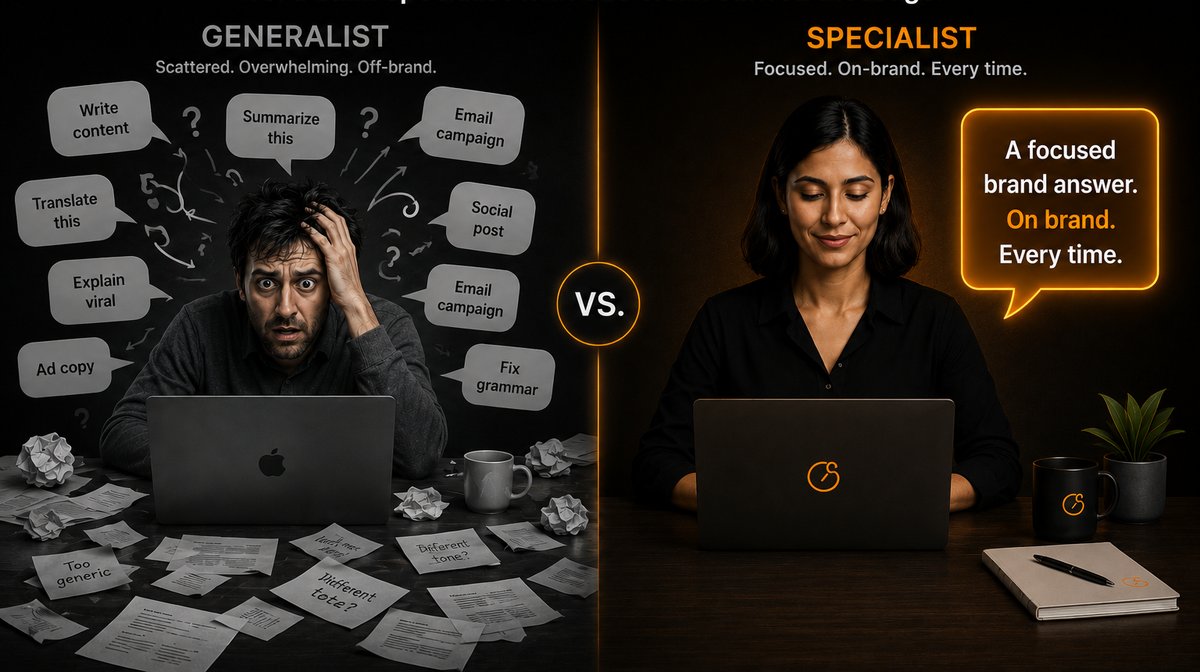
Here's the uncomfortable part. Those systems are generalists. They are extraordinary at general knowledge and useless at the specific, proprietary truth of your brand — your positioning, your guarantees, the line you'd never cross. When a generalist hits the edge of what it knows about you, it doesn't stop. It fills the gap with a plausible guess, stitched from old pages, stray reviews, and a competitor's framing. Confident, fluent, and quietly wrong.
You didn't approve this handover. It happened anyway.
The whole industry is moving to specialists — except your brand
This isn't a fringe worry. It maps onto the single biggest movement in applied AI today: the shift from one giant general model toward specialised, domain-grounded ones — and the specialists are winning.
Deloitte's Tech Trends 2025 describes the enterprise shift away from large general models toward “smaller, specialized systems” built for specific tasks, with small models that “work in concert.” McKinsey's read in Seizing the agentic AI advantage is that the foundation model itself isn't the source of advantage — proprietary data is; it calls a company's “walled garden of proprietary data” its superpower. The pattern is already visible: in medicine, law and code, purpose-built models match or beat far larger general ones in their domain.
A brand is a specialised domain. It has its own vocabulary, its own non-negotiables, its own truth. By the logic everyone in AI now accepts, it deserves a specialist — not a generalist guessing in the dark.
Hallucination is a sourcing problem, and that's good news
The most important finding for brands isn't that AI hallucinates. It's why, and what fixes it.
The Galileo Hallucination Index — an independent benchmark that scored 22 leading models at launch and now tracks more than 130 on a live leaderboard — measures how often models invent things across tasks with and without retrieval. The consistent result: when you ground a model in retrieved, verified context instead of letting it answer from memory, hallucination drops sharply.
Read that again, because it reframes the whole problem. The errors about your brand aren't an unfixable flaw in the model. They're a sourcing failure — the model never had your verified truth in front of it. Give it that truth, structured and authoritative, and the guessing largely stops. This is the same insight that produced retrieval-augmented generation (Lewis et al., 2020) and, more recently, ontology-grounded retrieval: better input produces better output, and the most leverage-rich input a business has is its own brand.
What kbie actually does
kbie turns your brand into a specialist AI — a verified source of truth that every model reads from.
It starts with the Brand Brain: a structured, nine-layer model of your brand — identity, audience, positioning, voice, visual, constraints, memory, objective, activation. Crucially, you author and verify it. It isn't scraped and assumed; it's confirmed by the people who actually own the brand. That distinction — verified-by-you versus guessed-from-the-internet — is the entire ballgame.
From there, the brain does its jobs. It composes — every piece of content your team generates is drawn through that one source of truth, so the voice is yours by construction, not by luck. It audits — kbie checks how answer engines actually describe you across ChatGPT, Gemini, Claude and the web, scores the gap, and feeds what it finds back in (this is AEO: optimising for the answer, not just the click). And it learns — the brain proposes what it's picked up, with the evidence, and you approve or reject it. Nothing enters your brand truth silently.
One more thing matters: kbie is model-agnostic. It doesn't lock you to one vendor's models. As the engines change — and they change monthly — your verified brain stays constant, and every engine reads from it.
Why this isn't us alone shouting into the void
In April 2026, Adobe launched its own brand brain — a living, AI-powered brand knowledge graph with a continuously-learning ontology at its core. We think that's the best news we could have asked for. When a company Adobe's size builds the same thing, the category stops being a pitch and becomes a fact. The question is no longer whether brands need a brain. It's which one.
Ours is the independent one. Adobe's lives inside Adobe's ecosystem and serves the enterprise. kbie is model-agnostic, AEO-native, and built for the growth brands the enterprise suites quietly price out — anywhere in the world. Same conviction, different door.
The real shift
For decades, brands managed perception the only way they could: through people. Briefs, guidelines, agencies, review cycles — human memory and human discipline, stretched across every team and every channel.
That model breaks the moment most of your brand's expression is generated by machines that have never read your brand book. The next decade of brand-building won't be won by the company that out-prompts everyone. It'll be won by the company that owns one verified source of truth every AI reads from — and treats its brand not as a document, but as infrastructure.
That's the change we're building for. A brand that's no longer a guess. A brand that's a fact, in every answer, on every engine, every time. That's kbie.
Sources
- Deloitte — Tech Trends 2025 ↗
- McKinsey — Seizing the agentic AI advantage ↗
- Galileo Hallucination Index ↗
- Adobe introduces Brand Intelligence ↗
- Retrieval-Augmented Generation (Lewis et al., 2020) ↗
kbie's own benchmark research (KBIF) is in peer review, targeted Q3 2026; this piece cites only external, published work.
Build your Brand Brain — start free →Related insights
- Clear the tension gate.
Why a few good questions make your brand's AI dramatically better.
- Brief once. Get answers your team can trust.
Stop re-prompting ten tools. Brief one brain, drawn from one verified truth.
- Your brand's deepest layers, in 45 minutes.
Settle positioning, voice and the lines you'd never cross — fast.