Clear the tension gate.
There's a quiet reason AI gets your brand wrong — and it's not the model. It's the gaps.

The real reason AI gets your brand wrong
There's a quiet reason AI gets your brand wrong, and it has almost nothing to do with the model. It's gaps.
When an AI doesn't actually know something about your brand — your real positioning, the promise you'd never break, the way you talk about price — it doesn't stop and admit it. It fills the gap with the most plausible-sounding guess. The output looks confident. It reads fine. And it's quietly off.
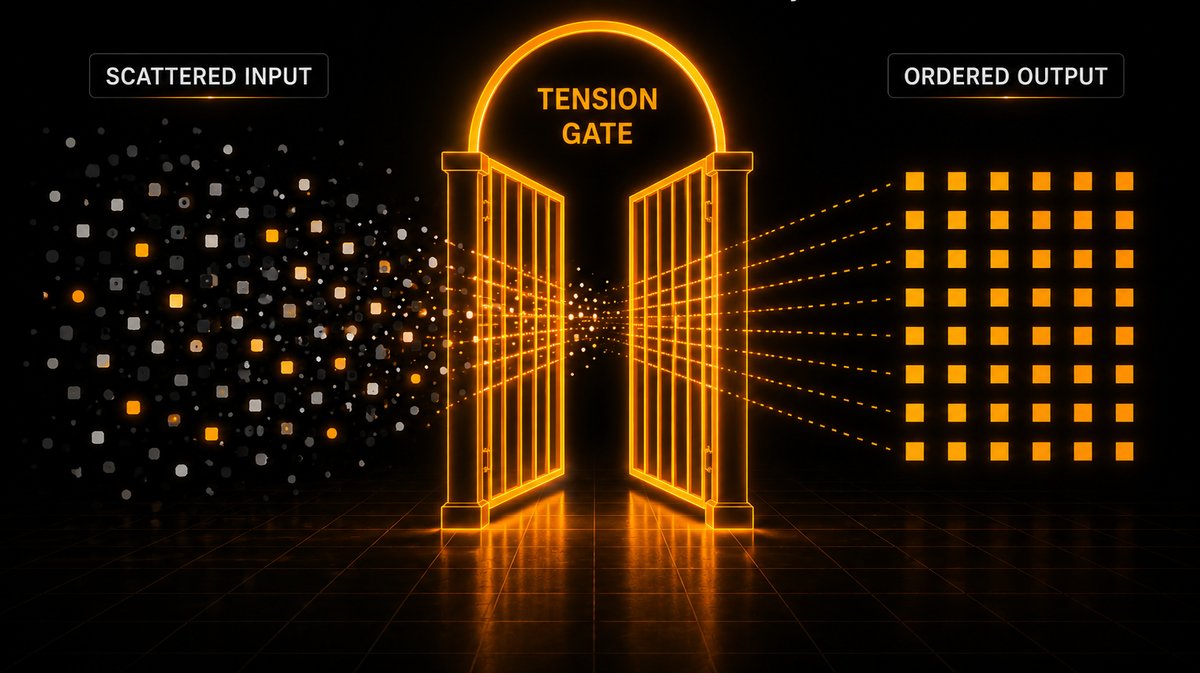
So the most valuable thing kbie does isn't generating content. It's refusing to guess. We call the moment it does that the tension gate.
What the tension gate actually is
When you bring a brand into kbie, it reads everything it can — your site, your decks, whatever you connect. But instead of pretending the picture is complete, it does something most tools skip: it shows you exactly where it's unsure.
Those uncertain spots are the tensions. Maybe your website says premium but your pricing reads value. Maybe your audience is described three different ways across three documents. Maybe a whole layer — your real objective, your hard compliance lines — was never written down anywhere.
The tension gate is the short, deliberate step where kbie surfaces those open questions and asks you to settle them. Not a forty-field form — a focused handful of the highest-leverage unknowns, each with an example answer so you're never staring at a blank box.
Why this is the whole game
Every gap you leave open is a place a generalist AI will improvise — and improvise differently every time, on every engine. Close the gap once, and you've closed the guess everywhere downstream: every draft, every audit, every answer ChatGPT or Gemini gives about you.
This is the same principle that makes grounded AI work. Independent benchmarks like the Galileo Hallucination Index show that when a model answers from retrieved, verified context instead of memory, it stops making things up. The tension gate is how kbie makes sure that context is actually complete — no quiet holes for the model to paper over.
A brand brain with gaps is a brain that guesses. A brain that's been through the tension gate is one the AI can trust.
What it feels like
It's fast, and it's skippable. You answer the questions you can, skip the ones you can't, and come back later. Each one is phrased the way a sharp strategist would ask it — and each shows a real example of a strong answer, so you're choosing and refining rather than writing from scratch.
You clear the gate once. From then on, the brain is whole — and everything it produces is built on what you confirmed, not what the internet assumed.
The payoff
When the tensions are resolved, three things change. Your content comes out consistent, because every tool draws from the same settled truth. Your brand stays compliant, because the lines you'd never cross are now explicit, not implied. And your AI presence holds up, because when an answer engine reaches for facts about you, the facts are there — verified, complete, yours.
The questions feel small. The effect isn't. Clearing the tension gate is the difference between an AI that talks about your brand and one that actually knows it.
Related insights
- Your brand's deepest layers, in 45 minutes.
Settle positioning, voice and the lines you'd never cross — fast.
- The generalist is already speaking for your brand.
Why specialist AI beats the generalist — and how to make your brand one.
- Brief once. Get answers your team can trust.
Stop re-prompting ten tools. Brief one brain, drawn from one verified truth.