Hallucination is a sourcing problem, not a model problem.
The errors AI makes about your brand aren't an unfixable flaw in the model. They're missing context — and that's solvable.

Why models make things up
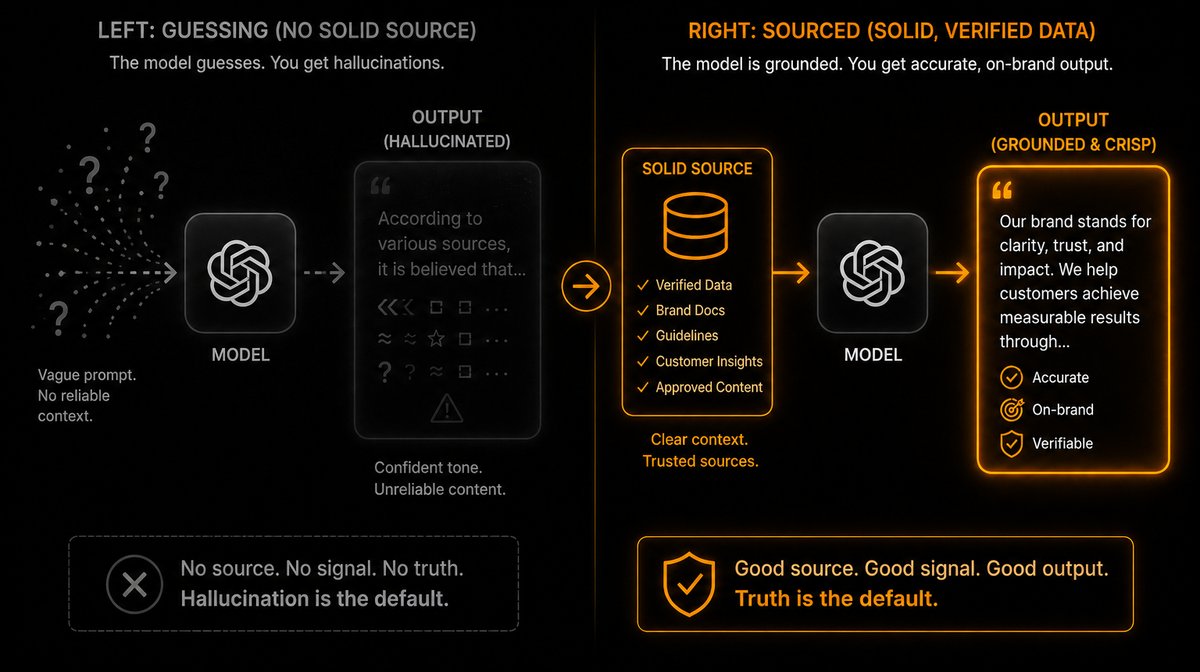
When a model doesn't have a fact, it doesn't stop and say so. It predicts the most plausible next words and keeps going — confident, fluent, and sometimes wrong. That's not a bug a bigger model patches; it's how the technology works when the context it needs isn't in front of it.
Which is exactly the situation your brand puts it in. The specific, proprietary truth of your brand is rarely in a model's training data, so it improvises.
The fix is grounding, not scale
Independent benchmarking makes this concrete. The Galileo Hallucination Index — which scored 22 leading models at launch and now tracks more than 130 on a live leaderboard — measures invention across tasks with and without retrieval. The consistent finding: when a model answers from retrieved, verified context instead of memory, hallucination drops sharply.
The lever isn't a bigger model. It's better input.
This isn't new — it's well-proven
Retrieval-augmented generation (Lewis et al., 2020) established years ago that injecting relevant retrieved knowledge into a model beats relying on its parametric memory for knowledge-heavy tasks. Ontology-grounded approaches have since extended the idea. Better, structured input produces better output. It's one of the most reliable results in applied AI.
What it means for your brand
Your brand is the most leverage-rich input you can hand an AI, because every customer-facing thing it generates depends on getting it right. kbie is a grounding layer for the brand domain: every output is retrieval-augmented by your verified Brand Brain. Give the model your truth, structured and authoritative, and the guessing about your brand largely stops.
Sources
Related insights
- The generalist is already speaking for your brand.
Why specialist AI beats the generalist — and how to make your brand one.
- Clear the tension gate.
Why a few good questions make your brand's AI dramatically better.
- Brief once. Get answers your team can trust.
Stop re-prompting ten tools. Brief one brain, drawn from one verified truth.